
Pull two jars of raw honey side by side and the first thing you notice is rarely the smell or the texture. It is the colour. One pours pale gold, almost straw. The other pours deep amber, sometimes almost black against the light. Same bee, same kind of jar, two completely different colours — and most people, looking at them for the first time, will quietly assume the darker one is somehow heavier, stronger, or more "real." That is not quite how the colour of honey works.
What honey colour actually depends on
The colour of any raw honey is mostly written before the jar exists. It is set by the flowers the bees worked, the mineral content of the nectar, the age of the honey, and — to a smaller extent — the conditions inside the hive while the honey ripened.
- Floral source. This is the biggest factor. Citrus blossom, acacia, and clover give pale, light honeys. Marjoram, wildflower, buckwheat, and many late-summer blooms give darker honeys. The pigments come straight from the nectar.
- Mineral content. Darker honeys generally carry more minerals — iron, manganese, potassium — which the bees gather from nectar produced on poorer or more mineral-rich soils. This is where the old folk idea that "darker honey is stronger" comes from. There is some truth in it, but it is a statistical truth, not a per-jar one.
- Age. Honey gets darker as it sits. A jar bottled in March from a fresh harvest will look paler than the same jar a year later. The change is slow and harmless — a Maillard-style reaction between sugars and trace amino acids, like the way a slow-baked loaf darkens.
- Heat. This is the only colour change you should worry about. Honey heated above 40°C darkens quickly and unevenly, and the new colour comes with a loss of aroma. We talk about this in how long does honey really last — heat is honey's only real enemy.
The honey colour scale
Internationally, raw honey is graded on a colour scale called the Pfund scale, which runs from "water white" at the lightest end to "dark amber" at the deepest. It is mostly used in trade — the categories are useful when you are buying barrels, less useful when you are eating from a jar.
For a kitchen, a simpler scale works better. Hold the jar up to indirect daylight (not the sun) and ask yourself which of these it is closest to:
- Water-white to extra-light amber. Acacia, fresh clover, some early citrus. Pours like olive oil, very mild flavour, almost grassy.
- Light to medium amber. Most fresh citrus honey, including our Raw Citrus Honey 3. Floral nose, gentle finish, most people's idea of "a good everyday honey."
- Medium to dark amber. Marjoram, wildflower, late-summer multifloral. More body, more aromatic, longer finish.
- Dark amber to almost black. Buckwheat, manuka, sometimes very mature multifloral. Strong, sometimes a little bitter, used more sparingly in a kitchen.
None of these is "better." They are different jobs. A water-white acacia is built for a glass of cold water on a hot afternoon. A dark amber is built for a slice of aged cheese.
What colour does not mean
Three things are worth saying clearly, because the internet says them wrong all the time.
Colour does not measure purity. A pale honey is not "watered down" and a dark honey is not automatically "richer." A pasteurised, ultra-filtered honey can be a beautiful pale gold and still be cooked-out and lifeless. A real raw honey can be almost colourless. The two facts have very little to do with each other.
Colour does not measure how raw a honey is. Raw simply means the honey has not been heated above hive temperature and has not been ultra-filtered. You can have a pale raw honey and a dark pasteurised one. We wrote more about that distinction in raw vs pasteurised honey.
Colour does not predict crystallisation. Crystallisation depends on glucose-to-fructose ratio, not on colour. A pale citrus and a dark wildflower can both crystallise within months — or both stay liquid for a year — depending entirely on their sugar profile, not their shade.
The Hive 7 citrus honey: a darker citrus than people expect
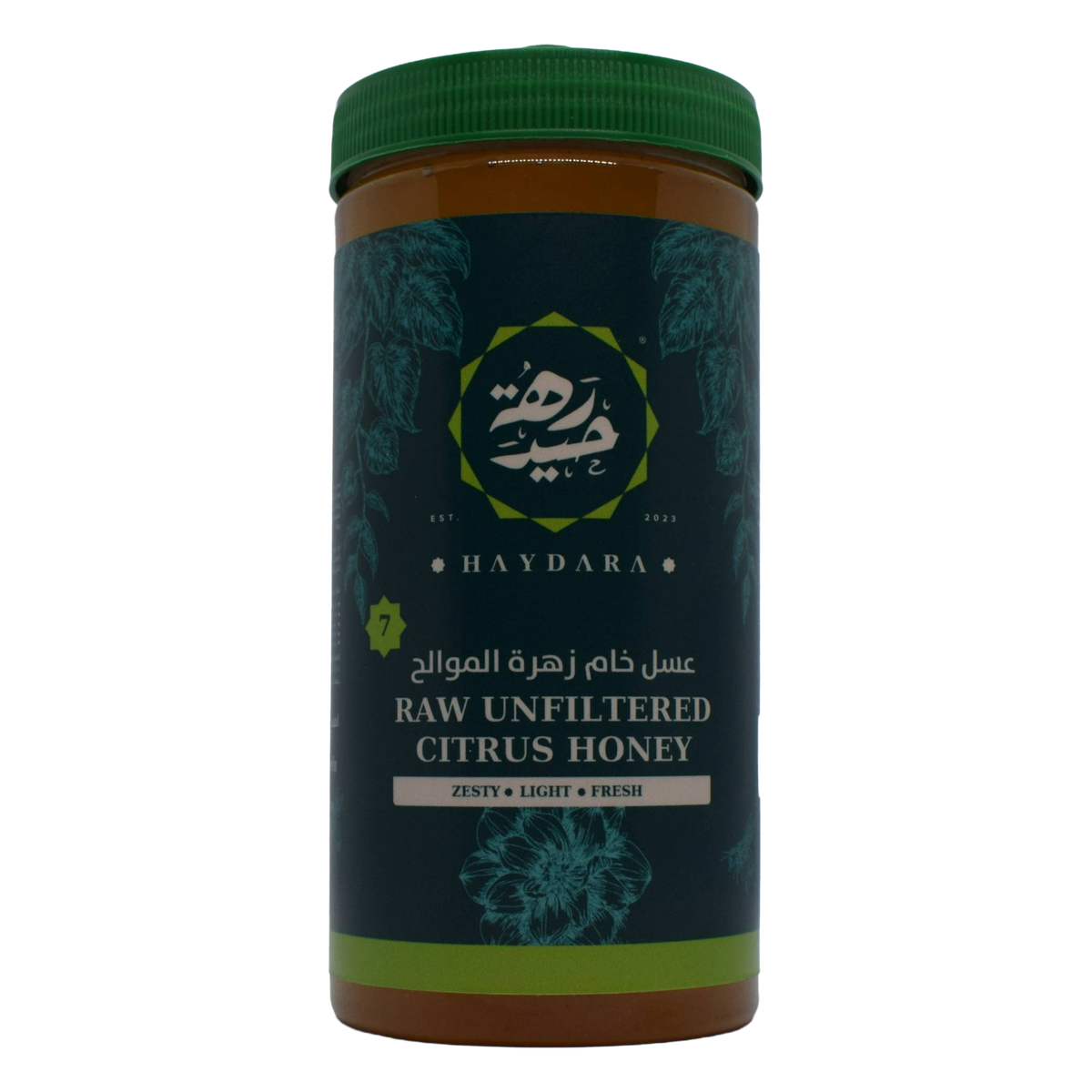
Our Raw Unfiltered Citrus Honey from Hive 7 in Sharkiya is a small, useful illustration of all of the above. People who know citrus honey from supermarkets often expect a pale gold. Hive 7 pours a deeper, browner amber than most citrus honeys — partly because it is unfiltered (the natural pollen and trace wax stay in), partly because the Sharkiya soils are heavier in minerals than the Fayoum orchards next door.
It is the same flower — citrus blossom from a managed orchard — and the same minimal handling we use in our traceability process. But it sits in the medium-amber range, not the light, and that surprises people who expect citrus honey to look like the supermarket version. The taste is unmistakably citrus; the colour is just honest about the soil and the lack of filtering.
How to read a jar in front of you
Before you buy a honey, especially from a small producer, three quick checks will tell you most of what you need:
- Hold the jar up to indirect daylight. Look for clarity, not brilliance. Real raw honey does not have to look "perfect." It can be slightly hazy, slightly grainy, slightly varied in colour from top to bottom. Ultra-clear, perfectly even honey is more often a sign of heavy filtering than of quality.
- Look at the colour at the edges and in the centre. A small variation is normal. A jar that is uniformly the same shade in every direction has often been processed to look that way.
- Check the colour against the floral source on the label. A label that says "citrus" but pours water-white is suspicious. A label that says "marjoram" or "wildflower" but pours pale gold is also suspicious. The colour and the floral source should at least roughly agree.
If you would like to taste two honeys with very different colours from the same producer, the Raw Citrus Honey 3 — 250g (light to medium amber) and a jar of our Raw Unfiltered Citrus Honey 7 — 800g (medium to dark amber) sit on opposite ends of "Egyptian citrus honey." Same flower, two different soils, two different colours, two different stories on the spoon.
Order via WhatsApp or the Haydara website when you are ready. And the next time someone tells you a darker honey is automatically a better honey, you will know enough to gently disagree.